
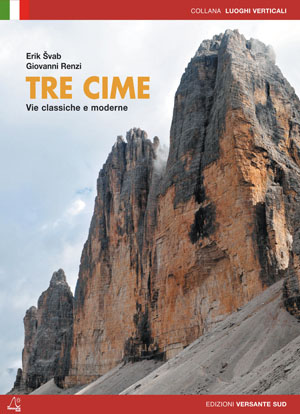
Tre Cimes (english version)
Auteur(s) : Erik Svab, Giovanni Renzi - Versante Sud - 2009
The Tre Cime di Lavaredo are amongst the icons of the Dolomites. The imposing structure of this triad, their overhanging and shadowy faces, their slender spires, have aroused in the past and still today, not only great interest but also complete respect.They are vertical and often overhanging faces, which require experience on rock which is not always good, as well as practical and psychological preparation.
The Tre Cime have been the destination in alpinism, from the early pioneers, of illustrious names in world alpinism, many of which have left their mark by opening new itineraries, making first repetitions, winter and solo ascents and link ups.
This guide compiles more than 100 routes, as well the classic itineraries it includes all the ascents which have been free climbed, both along the old aid routes as well as the more recent ones. Many of the routes described have been personally repeated by the authors, both excellent climbers and alpinists. It is an undertaking born from the wish to preserve the memory of the more difficult and less known routes, to prevent someone, unaware of them, from overlapping them with a line of bolts.
PREFACE BY CHRISTOPH HAINZ
It is obvious that the Tre Cime di Lavaredo deserve a guide book of their own since they are the Stars of the Dolomites. Besides, so many routes have been opened on these monumental blocks that it was quite easy to fill a whole book. Nowhere else can you find such a number of exceptional routes with so many different levels of difficulty.
(…)
Exactly 140 years ago, on 21 August 1869, the Austrian alpinist Paul Grohmann together with the guides Franz Innerkofler and Peter Salcher, reached the first and highest summit of the Tre Cime di Lavaredo. At that moment, the fortunate trio was as yet unaware of what would follow their pioneering achievement. In fact an international race began, to conquer this fortress, which even to this day has no equivalent. At the end of the 1990’s with Kurt Astner, we both as south Tyrolean climbers we took part in this race with opening hard new routes on the north face of Cima Grande and Cima Ovest, as well as on the south face of Cima Piccola; routes which then went on to become extreme classics. Shortly afterwards Mauro “Bubu” Bole attracted attention thanks to his hard first free ascents of old aid routes, while Alexander Huber take the climbing at levels of breathtaking difficulty with the free ascent of Bellavista, the Alps’ first 8c, creating one of the most difficult itineraries ever on rock. In this way these powerful faces came back on the scene and became once more a major attraction for the world’s best climbers.
(…)
I therefore wish all the readers of this guide book to live this unique experience with the right dose of awareness and respect for these mountains, but above all to enjoy the ascent of this fantastic trinity.
PREFACE BY ALEX HUBER
Throughout my life as a mountaineer I have tackled almost all the mountains of the world. Large and small walls, high and steep, rock and ice. All mountains, according to my perception, possess an intrinsic beauty, but beyond these some special mountains exist. K2, Cerro Torre, El Capitan, Mont Blanc and the Matterhorn – these are the most sought-after peaks in the panorama of summits: amongst these the Tre Cime are also included. In the heart of the unrivalled landscape of the Dolomites, the Tre Cime embody to perfection the spirit of climbing with their merciless steep north faces. Thomas and I were born into a family which loved alpine sports, consequently from an early age we were captivated by the world of mountains. Our father especially, who had in his turn climbed every classic Alpine face, is responsible for our addiction to the vertical world. At the age of fifteen for the first time I climbed Spigolo Giallo and the Comici route and it is then that I understood instinctively that I would climb the Cime di Lavaredo many more times.
In fact there is no other group of mountains which has seen me return so often. The Tre Cime di Lavaredo more than any other face has always challenged me; from climbing five routes in one day or making a solo ascent, to climbing the great roof of Cima Ovest. The Tre Cime to this day represents the touch-stone of everything. And will continue to do so in the future.
Enjoy your vertical adventure!
About the Authors
Erik Švab, born 1970 and living in Trieste, is married with two children and dedicates himself 100% to alpinism: sports climbing, modern and classic routes, trad routes, solo ascents, competitions, new routes, ice falls, dry-tooling, ice and mixed routes as well as expeditions. Throughout his twenty years of alpine activity he has achieved more than 500 ascents in the mountains.
He collaborates with the media and organises evening events for the public; he is a member of the Slovenian minority in Italy and speaks seven languages.
He is an honorary member of the Italian Academic Alpine Club. Since becoming a father his greatest achievement has been to reconcile high level alpinism with family life and career. He does his best by climbing around the Alps and Europe, in both summer and in winter.
Giovanni Renzi, born in 1966, lives in Bellaria (Rimini) where he is a business manager.
He started climbing in 1983 on the crag of Badolo and in 1995 became a National Free climbing Instructor.
He is assiduous in bringing attention to the crags of the Marecchia valley(www.valmarecchia.it) where he bolted roughly 250 single pitch routes which have been collected in the guide books: Arrampicare in Valmarecchia (2000), Valmarecchia Verticale (2005) e Verucchio (2008). In 2001 he set up the Scuola di Arrampicata Valmarecchia (Valmarecchia Climbing School) with whom he also manages an indoor gym near Rimini. He has climbed approximately 200 classic and modern itineraries in the Dolomites, 30 of which in Lavaredo. He has visited 300 crags in Italy and Europe climbing up to 7c on sight and 8a+ redpoint.
. Genre : livre neuf Prix : 25.50 €
(Cette fiche a été consultée 855 fois.)